GLP-1 · Appetite regulation
Glucagon-like peptide-1 signals fullness and helps regulate insulin release when blood glucose rises.
Explore Retatrutide, an investigational triple-receptor agonist targeting GLP-1, GIP and glucagon receptors. Learn about clinical research, weight-loss results, product specifications and availability in Bali.
Retatrutide is an experimental peptide medicine. A single molecule activates three receptors that help the body respond to food and regulate energy use. An agonist is a substance that switches on a receptor. “Triple” describes the three targets, rather than a mixture of three drugs.
Researchers are studying whether acting on these pathways together can change body weight and metabolic outcomes in people with obesity. The retatrutide used in the trials was supplied by the study sponsor. The studies do not establish the identity or performance of a separately branded pen.
Glucagon-like peptide-1 signals fullness and helps regulate insulin release when blood glucose rises.
Glucose-dependent insulinotropic polypeptide helps the pancreas respond to a meal. Its receptor is a second target shared with tirzepatide.
Glucagon helps the liver make glucose available. Researchers are also investigating its contribution to energy expenditure.
The receptor targets are known. To understand their contributions, it helps to distinguish what scientists saw in the laboratory from what they measured in people.
One retatrutide molecule can activate the GLP-1, GIP, and glucagon receptors. Laboratory tests characterize the activity at each target.
GLP-1 signaling can increase fullness and reduce food intake. Hunger and satiety also depend on many signals beyond these three receptors.
GIP contributes to glucose-dependent insulin release. Coskun and colleagues found that glucagon-receptor activity increased energy expenditure in mice. How much that pathway contributes to weight change in people remains uncertain.
Investigators assign participants to retatrutide or a comparator and measure changes in body weight. That comparison captures the combined effect of the molecule. It cannot attribute a fraction of a person’s weight change to each receptor.
In the 2023 phase 2 trial, Jastreboff and colleagues enrolled 338 adults with obesity or overweight and a weight-related condition. Participants received retatrutide or placebo. Week 24 was the primary endpoint. Week 48 provided a longer look at the same groups.
Estimated average weight reduction at week 48 in the 12 mg research group. The placebo group averaged a 2.1% reduction.
| Trial measure | 1 mg | 4 mg (pooled) | 8 mg (pooled) | 12 mg | Placebo |
|---|---|---|---|---|---|
| Baseline | 0% | 0% | 0% | 0% | 0% |
| Week 24 | −7.2% | −12.9% | −17.3% | −17.5% | −1.6% |
| Week 48 | −8.7% | −17.1% | −22.8% | −24.2% | −2.1% |
At the primary endpoint, average weight reductions ranged from 7.2% in the 1 mg group to 17.5% in the 12 mg group. The placebo group averaged 1.6%. The chart includes every published target-dose group.
The groups continued to diverge after week 24. By week 48 the combined 4 mg and 8 mg groups averaged reductions of 17.1% and 22.8%. The same paper reported 24.2% for the 12 mg group.
The percentages describe estimated changes from each group’s own starting weight. The 24.2% figure includes the entire change in the 12 mg group. Subtracting the placebo group’s change answers a different question.
In the separate 2026 TRIUMPH-1 publication, 2,339 adults underwent randomization. At week 80, the intention-to-treat analysis reported weight changes of −17.6%, −23.7%, and −25.0% in the 4 mg, 9 mg, and 12 mg groups, respectively, and −3.9% with placebo. These are results from a new study.
Participants met specific entry criteria and had scheduled follow-up. Group averages conceal variation among individuals. The phase 2 study lasted 48 weeks and could not establish the frequency of rare harms or the effect of the drug over many years. Neither trial tested the pictured Body Pharm pen.
Choose your starting weight and a published time point. Compare the recorded group averages in kilograms or pounds.
Average weight change
24.2%This is a mathematical illustration of a published clinical trial average, not a prediction of your personal results.
Selected group: 12 mg research group.
View the published resultsBoth molecules target GIP and GLP-1. A third target, the glucagon receptor, distinguishes retatrutide. Their clinical and regulatory histories differ as well.
| Feature | Retatrutide | Tirzepatide |
|---|---|---|
| Drug class | Triple receptor agonist | Dual receptor agonist |
| GLP-1 receptor | Yes | Yes |
| GIP receptor | Yes | Yes |
| Glucagon receptor | Yes | No |
| Weight-management evidence | Placebo-controlled phase 2 and phase 3 trials | Multiple phase 3 trials, including SURMOUNT-1 |
| US regulatory status | Investigational | Specific Mounjaro and Zepbound products have FDA approval |
Tirzepatide acts on two incretin receptors. Retatrutide adds glucagon-receptor activity. The number of targets alone cannot tell us which medicine produces a larger change in weight or a different pattern of adverse effects.
Each molecule has produced greater average weight loss than placebo in trials enrolling adults with obesity. Retatrutide’s phase 2 study and tirzepatide’s SURMOUNT-1 study randomized participants separately.
Eligibility, follow-up, and statistical methods differed across those studies. The direct retatrutide–tirzepatide comparison is TRIUMPH-5. Its registry listed no results when this guide was reviewed in November 2026.
Digestive symptoms were the most common side effects in the phase 2 study and were usually mild or moderate. Investigators also measured a dose-related rise in heart rate that peaked at week 24 and declined over the remainder of follow-up.
FDA identifies retatrutide as an ingredient in no FDA-approved drug. The developer describes access to its investigational product through clinical trials. No BPOM registration has been verified for the Body Pharm 32 mg pen in Indonesia.
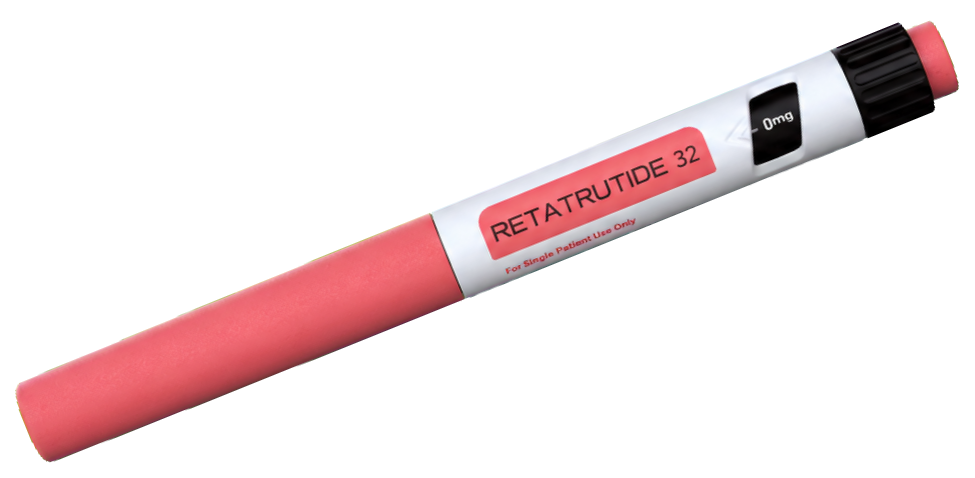
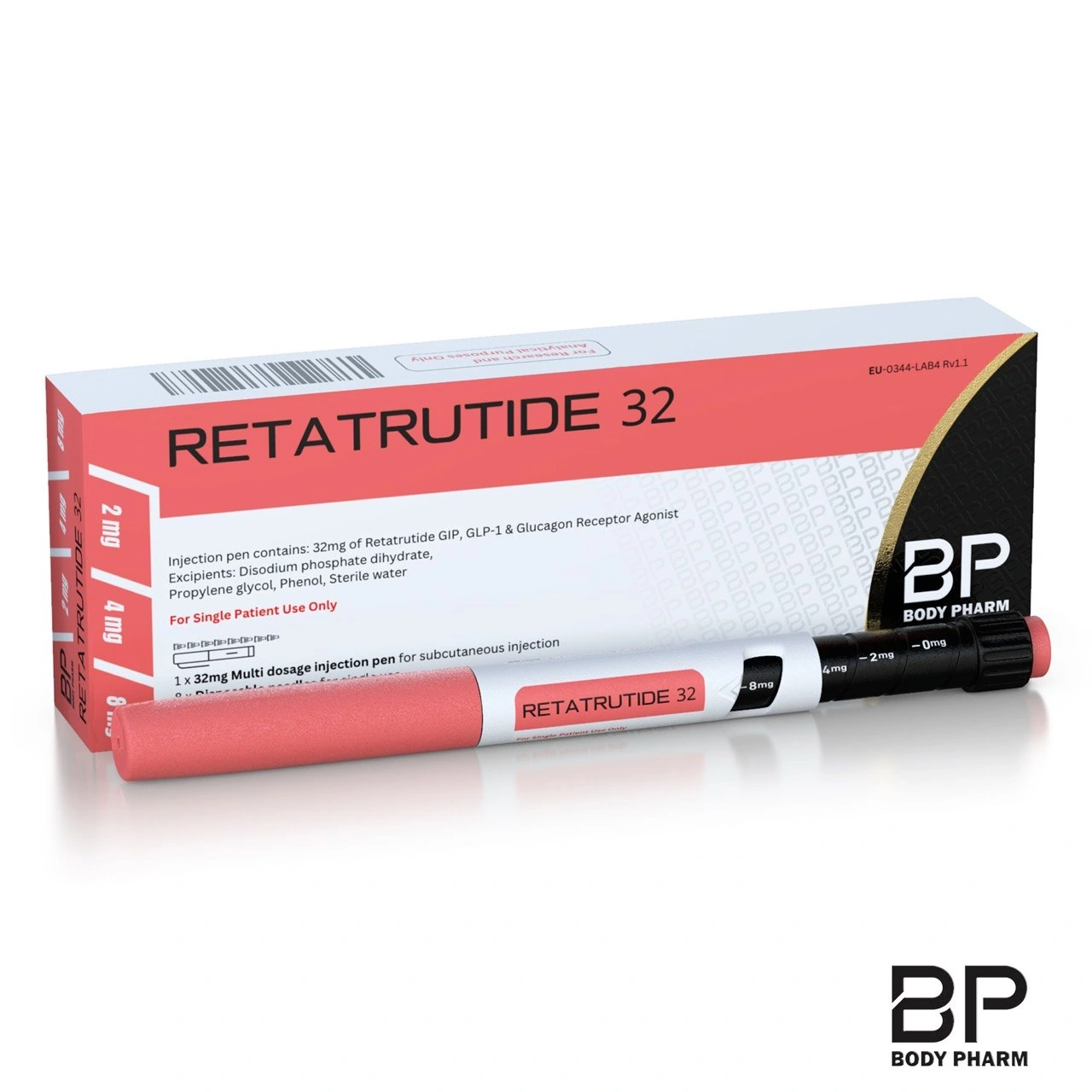
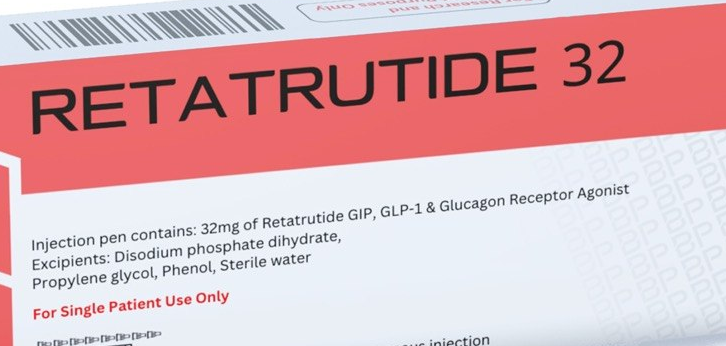
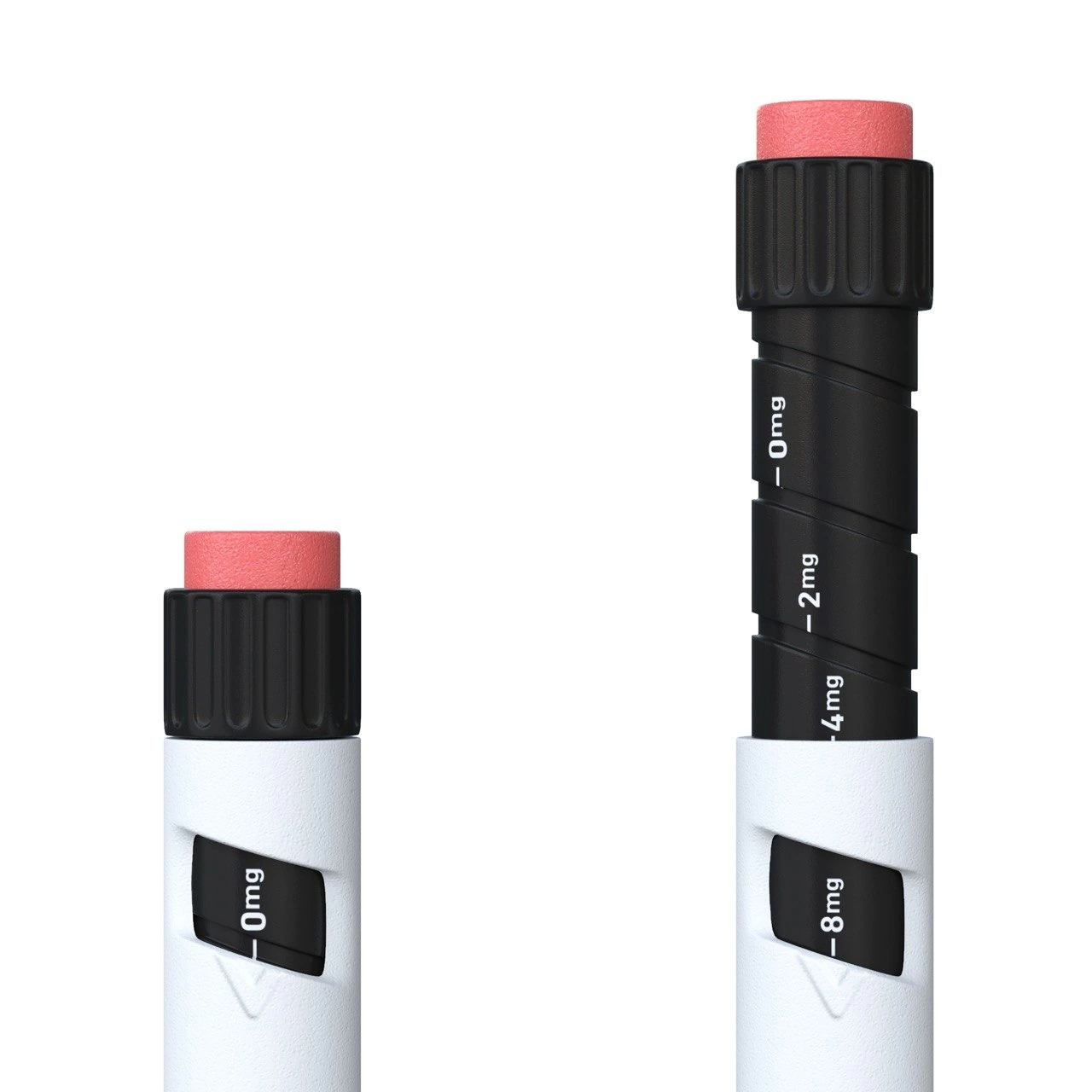
Look for RETATRUTIDE 32 on both the box and the pen. The photograph of the selector shows the same pen from the other end.
| Specification | Details |
|---|---|
| Product | Retatrutide |
| Brand | Body Pharm |
| Format | Prefilled pen |
| Total per pen | 32 mg |
| Price per pen | IDR 4,000,000 |
| Storage on the label | 2–8°C, protected from light |

You can read the manufacturer’s report here. To check your own carton, ask for the document with the same batch number as the box.
The label gives a storage range of 2–8°C. Keep the carton away from light and the freezer. If it arrives warm or damaged, keep the packaging and contact the team before using it.
See the amount and price for each complete pen.
Retatrutide is an investigational peptide that activates the receptors for GLP-1, GIP, and glucagon. Researchers are studying its effects on body weight and other metabolic outcomes. In obesity trials it has been compared with placebo under controlled conditions. The 32 mg label on the Body Pharm pen describes a separate catalog item.
Retatrutide acts on three hormone receptors. GLP-1 and GIP are involved in the body’s response to eating, and glucagon signals the liver to make glucose available. Preclinical experiments also suggest a role for energy expenditure. Human trials measure the overall response to the molecule. They cannot separate out how much weight change comes from each receptor.
It has GLP-1 receptor activity. Calling it a triple agonist gives a fuller description because it also activates GIP and glucagon receptors. Single-target GLP-1 medicines and investigational retatrutide have different sets of receptors and different regulatory histories.
An agonist activates a receptor, a protein that receives a signal in the body. A triple agonist can activate three kinds of receptor. In this case one peptide has activity at the GLP-1, GIP, and glucagon receptors. The term describes its targets. It carries no claim about the size of an individual's response.
Both activate GIP and GLP-1 receptors. Retatrutide also activates the glucagon receptor and remains investigational. Specific tirzepatide products have approvals for defined indications. The phase 2 retatrutide trial and the 72-week SURMOUNT-1 tirzepatide trial used different participants and designs. TRIUMPH-5 is the registered direct comparison of the two molecules.
The 2023 phase 2 trial found greater average weight reductions with retatrutide than placebo at both 24 and 48 weeks. A separate phase 3 trial, TRIUMPH-1, reported an average 25.0% reduction in its 12 mg group at week 80 and 3.9% with placebo in the intention-to-treat analysis. Group results depend on the study population and follow-up.
In the phase 2 trial, estimated mean weight reductions were 8.7% in the 1 mg group, 17.1% in the combined 4 mg group, 22.8% in the combined 8 mg group, and 24.2% in the 12 mg group. Placebo averaged 2.1%. The milligram labels identify study groups. The percentages refer to change from starting body weight.
Digestive symptoms, including nausea, diarrhea, vomiting, and constipation, were reported in the phase 2 trial. Most were mild or moderate and occurred more often in higher-dose groups. The investigators also recorded increases in heart rate. A trial of this size and duration provides limited information about uncommon or long-term adverse effects.
No. FDA says retatrutide is not an ingredient in any FDA-approved drug. Published studies and a phase 3 development program establish that the molecule is being investigated. They do not authorize commercial pens labeled with its name. The references include FDA’s current notice on unapproved products.
The Bali catalog pictures a Body Pharm prefilled pen labeled “Retatrutide 32 mg.” Lilly describes its investigational retatrutide as available through its clinical trials. The catalog listing and photographs do not establish that the pen is sponsor-supplied trial medication or authorized for human use.
It is the manufacturer’s stated total amount in the entire pen. The number does not state the amount delivered in a particular injection or how long a pen would last. It is a packaging specification, and it serves a different purpose from the target-group labels used in the research chart.
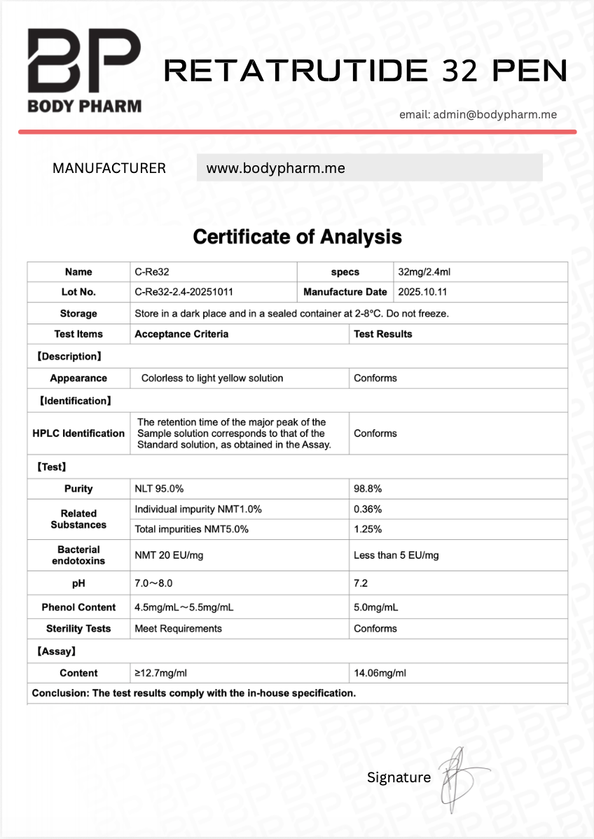
The manufacturer’s certificate shown here identifies lot C-Re32-2.4-20251011. Compare that exact code with the lot on the supplied pack. The report lists separate results for identification, purity, sterility, and bacterial endotoxins. Each result concerns the submitted sample. The certificate cannot authenticate a different lot or establish an Indonesian marketing authorization.
For lot C-Re32-2.4-20251011, the Body Pharm certificate specifies a sealed container in a dark place at 2–8°C and says to avoid freezing. Check the instructions and expiry on the supplied pack. The report documents the manufacturer’s storage conditions for the named lot.
We could not verify an Indonesian BPOM marketing authorization for the Body Pharm Retatrutide 32 mg pen. Lilly describes its retatrutide as investigational. BPOM’s public medicines database lets readers check the product name, registration holder, presentation, and registration number. A contact or listing in Bali does not establish approval.
Jastreboff and colleagues published the 2023 phase 2 trial and the 2026 TRIUMPH-1 trial in the New England Journal of Medicine. Their article records appear in the references below. ClinicalTrials.gov record NCT04881760 describes the phase 2 protocol. For the direct comparison with tirzepatide, consult NCT06662383.
The primary endpoint was body-weight change at week 24. At week 48, mean weight change ranged from −8.7% to −24.2% in active groups and was −2.1% with placebo.
Read Original StudyThe intention-to-treat analysis estimated −25.0% body-weight change in the 12 mg group and −3.9% with placebo. This is a separate population from the phase 2 study.
Read Original StudyExperiments identified three receptor targets. Increased energy expenditure was observed in mice. The early human study examined tolerability and exposure.
Read Original StudyThe registration identifies the treatment arms, inclusion criteria, and prespecified 24- and 48-week weight endpoints.
View the trial recordThis trial compares retatrutide with tirzepatide in adults with obesity. No results were posted in the registry at review in November 2026.
View the trial recordFDA identifies retatrutide as an ingredient in no FDA-approved drug. The notice distinguishes approved medicines from products sold under an ingredient name.
Read the official informationCheck an exact medicine by its registered name and registration number. A BPOM authorization for this Body Pharm pen has not been verified.
Open the Indonesian medicines registerThe developer describes retatrutide as investigational and limits access to its trial medicine to clinical trial participants.
Read the developer’s informationTell us how many Retatrutide pens you want and where in Bali you are staying. We can confirm availability, the delivered price and a time that works for you.